
In the world of search engine optimization, data is everything. Guessing which websites are worth pursuing for backlinks, which competitors are outranking you, or whether your own site is gaining authority — without real metrics — is like navigating without a map.
That’s exactly why the Moz DA PA checker has become one of the most widely used SEO tools on the planet. It gives you instant, reliable authority scores for any domain or page, backed by Moz’s industry-trusted algorithm. And when you combine that with bulk checking capability, you can analyze hundreds or thousands of URLs at once — turning what used to take days into a task that takes seconds.
This guide covers everything you need to know: what DA and PA mean, how to read the data, how to use a bulk checker effectively, and what to do with the results.
What Does Moz DA PA Actually Measure?
Before diving into how to use the tool, it’s important to understand what these numbers actually represent — and what they don’t.
Domain Authority (DA): The Big Picture Score
Domain Authority is a logarithmic score from 1 to 100 that predicts a website’s overall ability to rank across search engines. Developed by Moz, it’s calculated based on the strength and quality of a website’s entire backlink profile.
Key characteristics of DA:
- Logarithmic scale — It’s much easier to grow from DA 10 to 30 than from DA 60 to 80.
- Relative, not absolute — A DA of 45 isn’t “good” or “bad” on its own; it’s only meaningful compared to competitors.
- Not a Google metric — DA is Moz’s proprietary score, not used directly by Google’s algorithm. However, it strongly correlates with real-world ranking performance.
- Fluctuates regularly — Moz updates its index often. Your DA can change even if you haven’t built or lost any links, because the entire web is being recalculated.
What makes a good DA score?
| DA Range | Interpretation |
| 1 – 20 | New or low-authority site |
| 21 – 40 | Below average; room to grow |
| 41 – 60 | Average to good authority |
| 61 – 80 | Strong, competitive domain |
| 81 – 100 | Elite authority (major brands, news sites) |
Page Authority (PA): The Page-Level Score
Page Authority applies the same 1–100 scoring model to individual URLs rather than entire domains. A page can have a very different PA from its domain’s DA — for example, a high-authority homepage on a DA 70 site might link out to a product page with a PA of only 22.
PA is calculated using:
- Backlinks pointing to that specific URL
- Internal links flowing into the page
- Content trust signals at the page level
When does PA matter most?
- When building links to a specific landing page or blog post
- When evaluating the strength of a competitor’s ranking page
- When deciding which internal pages to prioritize for link juice
- When choosing which existing pages to update and republish for ranking gains
The Five Metrics Our Bulk DA PA Checker Shows You
Our free bulk Moz DA PA checker doesn’t just give you two numbers. It provides a complete authority snapshot for every URL you submit:
① Domain Authority (DA)
The domain-wide authority score from 1–100. Your benchmark for comparing sites against each other.
② Page Authority (PA)
The page-level authority score from 1–100. Essential for evaluating individual URLs in link building and competitor research.
③ Spam Score
A percentage from 0–100% that indicates how likely a website is to be penalized or considered low-quality by search engines. Moz calculates this by identifying patterns common across spammy or penalized sites.
- 0–30% — Low spam risk. Generally safe to associate with.
- 31–60% — Medium risk. Investigate further before linking.
- 61–100% — High risk. Avoid these sites for link building; consider disavowing if they link to you.
④ Total Backlinks
The complete count of inbound links to the URL or domain. Useful for understanding raw link volume, though quality always matters more than quantity.
⑤ Referring Domains
The number of unique domains linking to the URL. This is often the most important link-building metric — 500 links from 500 different domains is far more powerful than 5,000 links from a single website.
7 Real-World Use Cases for a Bulk DA PA Checker
Understanding the metrics is one thing. Knowing how to use them in real SEO workflows is where the value really lives.
1. Vetting Link Building Prospects at Scale
When running a link building campaign, you’ll generate a list of hundreds of potential sites to approach. Manually checking each one is not viable. With our bulk DA PA checker, you can:
- Paste your entire prospect list at once
- Filter out sites with DA below your threshold (e.g., DA < 30)
- Eliminate any site with a Spam Score above 30%
- Prioritize outreach toward high-DA, low-spam sites
This instantly transforms a raw list into a qualified, tiered outreach pipeline.
2. Competitor Backlink Profile Analysis
Export your competitor’s backlink list from any SEO tool, paste it into our bulk checker, and within seconds you’ll know:
- Which referring domains have the highest DA and PA
- Where the strongest links are coming from
- Whether any of your competitor’s links come from spammy sources
This intelligence lets you replicate their best links and outperform their weakest ones.
3. Guest Post Opportunity Evaluation
Before accepting or pitching a guest post, always verify the site’s metrics. A site that looks legitimate might have a DA of only 8 and a Spam Score of 65% — making the link essentially worthless (or worse, harmful).
Run every guest post prospect through the bulk checker before committing your time or budget.
4. Toxic Link Audit
If you’ve experienced a traffic drop or Google penalty, your backlink profile may contain toxic links. Export all your backlinks, run them through the bulk DA PA checker, and flag any domains with:
- Spam Score above 40%
- DA of 1–5 with unusually high backlink counts (link farms)
- Mismatched, irrelevant referring domains
Use the export feature to build a disavow file for Google Search Console.
5. Tracking Your Own Authority Over Time
Run your own domain through the checker monthly and log the results. As your content and link building efforts compound, you’ll see your DA and PA grow. This trend data is powerful for:
- Proving ROI to clients
- Justifying continued SEO investment
- Identifying when a link building strategy is or isn’t working
6. Evaluating Websites for Purchase or Partnership
If you’re buying an aged domain, acquiring a website, or entering a content partnership, DA and PA are critical due-diligence metrics. A high DA with low spam score and strong referring domains suggests genuine authority. A high DA with a suspiciously large backlink count from few domains may indicate manipulation.
7. Agency Client Reporting
Generate a bulk report for all your client domains and their competitors in one pass. Export to CSV and drop it into your reporting dashboard. Clients love seeing authority scores improve — and bulk checking makes generating those reports fast and effortless.
How to Use the Bulk Moz DA PA Checker: Step-by-Step
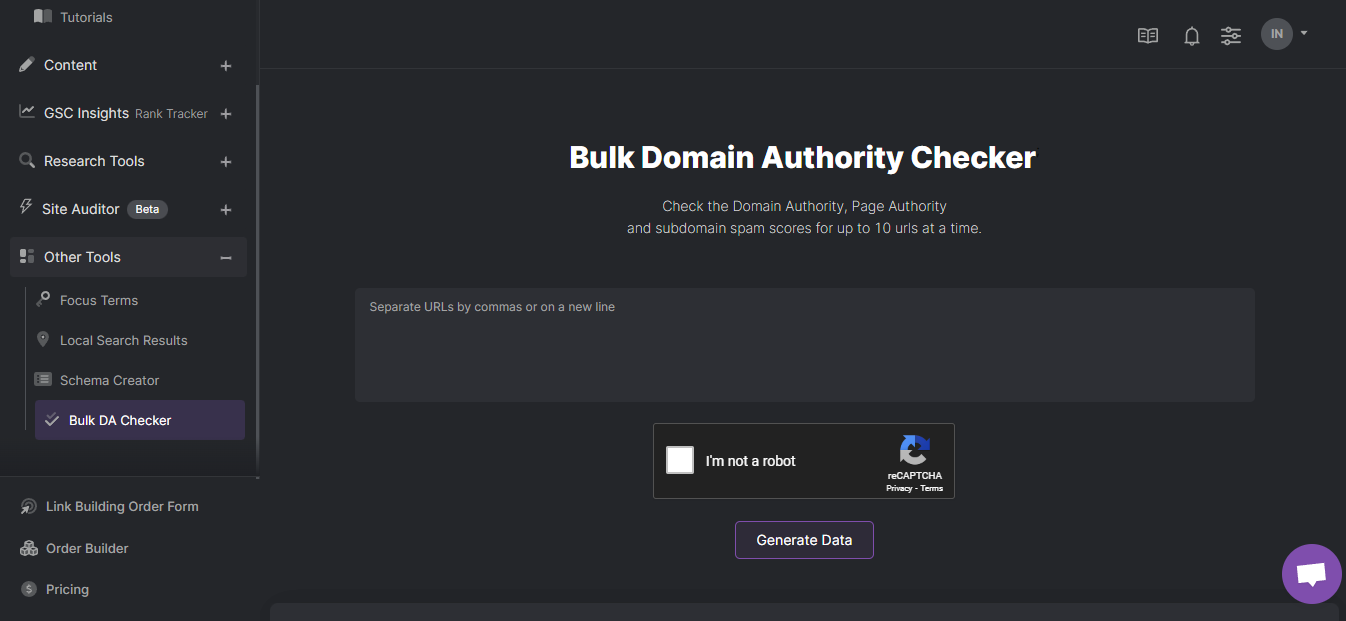
Our tool is designed to be fast, clean, and completely free — no account, no login, no API key required.
Step 1: Collect Your URLs Gather all the domains or page URLs you want to analyze. These can be competitors, link prospects, your own pages, or a client’s backlink list.
Step 2: Format Your List Enter each URL on its own line. You can mix domains (example.com) and full page URLs (example.com/blog/post) — the tool handles both.
Step 3: Submit for Analysis Paste your list into the input field and click Check DA PA. The tool processes all URLs simultaneously and returns results within moments.
Step 4: Review the Data Scan results for DA, PA, Spam Score, backlinks, and referring domains. Sort by any column to quickly surface the highest-value or highest-risk URLs.
Step 5: Export and Act Download your results as a CSV. Use the data to prioritize outreach, build a disavow file, create client reports, or update your SEO strategy.
Common Mistakes When Using DA and PA Data
Even experienced SEOs misuse authority metrics. Avoid these traps:
Mistake 1: Treating DA as a Google Ranking Factor DA is Moz’s metric — not Google’s. It correlates with rankings but isn’t directly used by Google’s algorithm. Use it as a proxy, not an absolute truth.
Mistake 2: Ignoring Spam Score A site can have a decent DA of 35 but a Spam Score of 75%. Always check both. High spam cancels out decent authority.
Mistake 3: Chasing DA Instead of Relevance A DA 80 link from an irrelevant industry is less valuable than a DA 45 link from a highly relevant, trusted source in your niche. Relevance still matters enormously.
Mistake 4: Checking DA Once and Never Again DA changes. Check it regularly — especially if you’re tracking competitors or measuring your own growth.
Mistake 5: Judging a Page by Its Domain’s DA Alone A DA 60 domain doesn’t mean every page has PA 60. Always check the specific page’s PA when evaluating link placement value.
DA PA Checker FAQs
Is the Moz DA PA checker really free? Yes — completely free, with no usage caps, no account required, and no hidden costs. Analyze as many URLs as you need.
How many URLs can I check in bulk? Our tool supports bulk analysis of thousands of URLs in a single session. It’s built for scale.
Is DA the same as Google PageRank? No. Google PageRank is Google’s internal algorithm (largely deprecated from public view in 2016). DA is Moz’s independent metric that predicts ranking potential using its own link index.
How often should I check my DA? Monthly is a good cadence for tracking your own domain. For link prospecting, check before every outreach campaign.
Can a new website have a high DA? Not immediately. DA grows over time as a site earns quality backlinks. Shortcuts — like buying links — often result in a high Spam Score, which undermines authority.
What is a safe Spam Score for link building? Aim for sites with a Spam Score below 30%. Between 30–60%, proceed with caution. Above 60%, avoid entirely.
Final Thoughts: Make DA PA Checking Part of Your SEO Workflow
The Moz DA PA checker is not just a one-time diagnostic tool — it’s a workflow essential. Every link building decision, competitive analysis, site audit, and client report benefits from fast, accurate authority data.
Our free bulk DA PA checker gives you Domain Authority, Page Authority, Spam Score, total backlinks, and referring domains for thousands of URLs in a single pass — with no login, no payment, and no friction.
If you’re serious about SEO, make it a habit. Check before you pitch. Check before you publish. Check before you partner.
Paste your URLs now and get your full authority report — free, instant, and built for scale.
